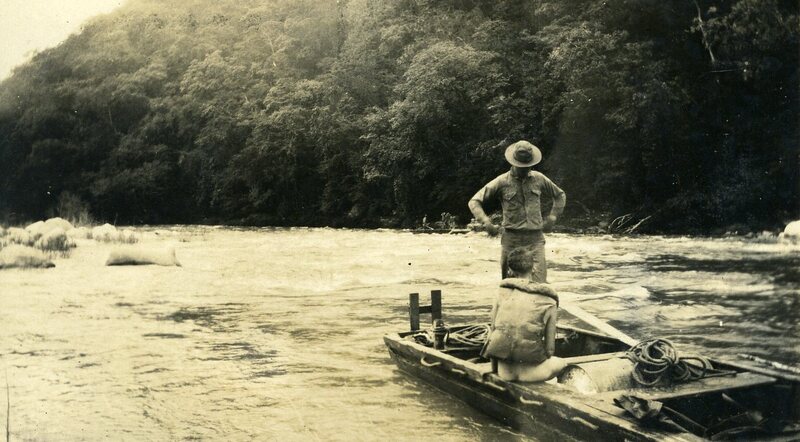
Two Marines in Boat on Coco River
"As early as February 1910, Marine Units and Navy vessels had begun to concentrate in Nicaraguan waters..."[1]
Thus opened over two decades of intense US Marine Corps involvement in the central American country of Nicaragua. From protecting private property for American business interests, to patrolling massive swathes of jungle and overseeing elections Marines were responsible for playing a rapidly increasing military role in American foreign policy.
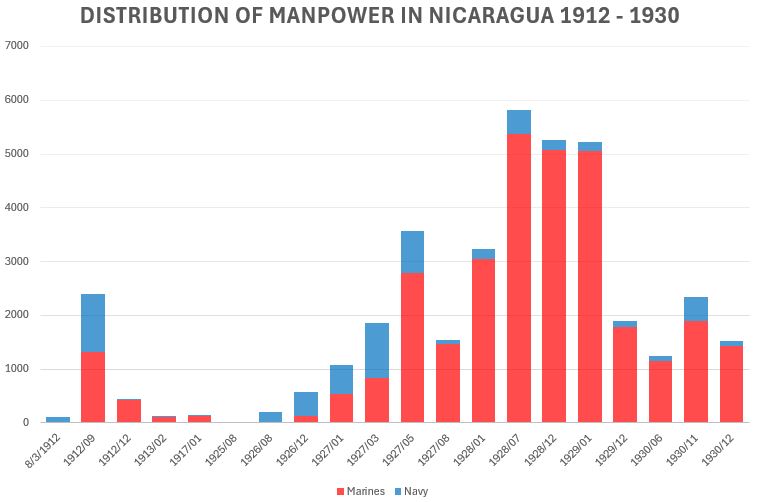
Fig.1 Shoreline manpower numbers are derived from Naval Intelligence compilations found in COLL 3978.
Much has been written from the perspectives of the military on the success of operations, of lessons learned, and of how integrating new technologies (like air power) were tested in blood during the conflict in Nicaragua. Many of these lessons were later refined on the battlefields of World War II. However, this project seeks to recover a perspective of the Marines who experienced the daily struggles and triumphs while executing their mission in Nicaragua. From patrolling the mountain jungles for Sandino's bandits to braving the rapids of the Coco River to writing letters in the restless downtime in camp, the Marines in Nicaragua experienced all manner of somatic experiences.
These experiences were borne out in letters, photographs, records of service, novels, newspaper reporting, and the bodies of the Marines themselves. Through cataloging and interpreting these experiences this project hopes to add to the history of the senses, particularly in the realm of the military, and help capture how Marines interpreted meaning out of these sensations.[2]
Today's Marine might find solace or perhaps dismay in the familiarity of discomfort encountered in the history of the Nicaraguan deployment. The meaning of the history of the senses is borne out, ultimately, in the fellowship they engender. That no Marine, despite 100 years of distance is alone in their physical irritation, mental stress, and malaise. That the disquiet of the terrain, the hostility of the animals, the weather, foul stench of the effects of dysentery, and the enemy, serve not only to tear the Marine down, but also, strangely, to nevertheless connect him more deeply to other Marines.
Sources:
All collections courtesy of the United States Marine Corps History Division. This project is made possible by George Mason University.
This site was created and is maintained by Jessica Lee Carson.
Featured Collection
Coco River Expedition
On 4 September Marines from 2 Division, 11th Battalion led by Captain Peter Geyer and Captain Harold Roberts set out to clear the Coco River from…
Recently Added Items
Harold C. Roberts, Correspondence from Harold C. Roberts to Faith N. Roberts 17 and 23 May, 1928
Harold C. Roberts 17-23 May, 1928, Correspondence from Harold C. Roberts to Faith N. Roberts 17 and 23 May, 1928
, Correspondence from Harold C. Roberts to Faith N. Roberts 17 and 23 May, 1928, COLL 2678, Archives Branch, Marine Corps History Division, Quantico, VA, 1.
One two page letter sent from Pueblo Nuevo detailing a nine day patrol covering 112 miles. One two page letter discussed telegram intercepted from a…
Tags: bandit, faith roberts, harold roberts, honduras, marines, mountains, pueblo nuevo, scenery, usmc
Harold C. Roberts, Correspondence from Harold C. Roberts to Faith N. Roberts 4 March, 1928
Harold C. Roberts 4 March, 1928, Correspondence from Harold C. Roberts to Faith N. Roberts 4 March, 1928
, Correspondence from Harold C. Roberts to Faith N. Roberts 4 March, 1928, Folder 11, COLL 2678, Archives Branch, Marine Corps History Division, Quantico, VA, 1
Three page letter sent from Condego detailing an intelligence gathering patrol that Roberts led to Daraili in order to map the ambush he referenced in…
Tags: ambushs, daraili, faith roberts, harold roberts, marines, usmc
Harold C. Roberts, Correspondence from Harold C. Roberts to Faith N. Roberts 29 February, 1928
Harold C. Roberts 29 February, 1928, Correspondence from Harold C. Roberts to Faith N. Roberts 29 February, 1928
, Correspondence from Harold C. Roberts to Faith N. Roberts 29 February, 1928, Folder 10, COLL 2678, Archives Branch, Marine Corps History Division, Quantico, VA, 1.
Four page letter sent from Condega detailing an ambush the day prior by Sandino. Includes a hand drawn map of the ambush (page 2). Five Marines KIA, 7…
Tags: ambushs, condega, drawing, faith robert, harold roberts, machine gun, marines, usmc, yali river