Lt Roberts Arrives in Nicaragua January 1928
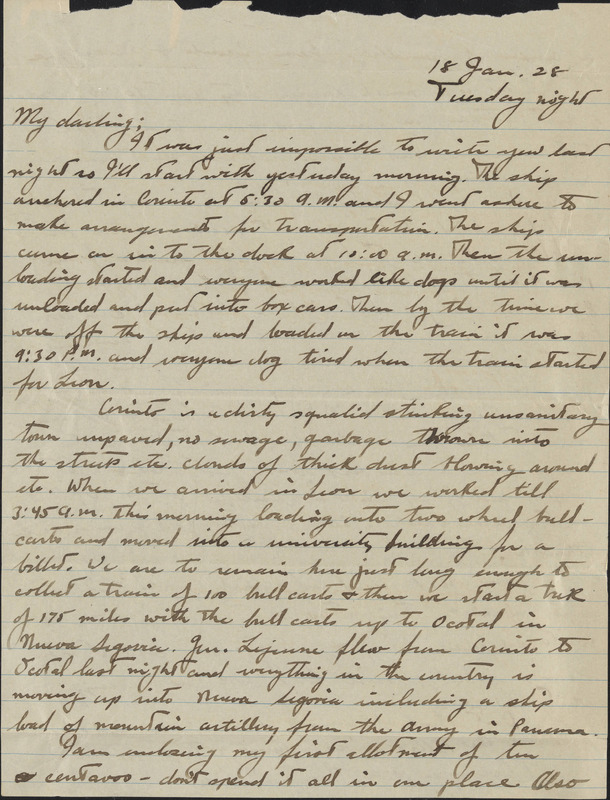
"The ship anchored in Corinto at 5:30 a.m. and I went ashore to make arrangments for transportation. The ship came on in to the dock at 10:00 a.m. Then the unloading started and everyone walked like dogs until it was unloaded and put into box cars. Then by the time we were off the ship and boarded in the train it was 9:30 p.m. and everyone dog tired when the train started for Leon."[1]
So penned Lt. Harold Cyrus Roberts in a letter to his wife, Faith, on the 18 of January, 1928. He had arrived the day earlier with nearly 1,000 other Marines and Sailors from ports across the country: Charleston, Hampton Roads, and San Diego.[2] Having landed in Corinto and packed into a train bound for the second largest city, Leon, Roberts reflected on his brief time in the port town he had just left with a critical eye: "Corinto is a dirty squalid stinking and unsanitary town unpaved, no sewage, garbage thrown into the streets etc. clouds of thick dust howing around etc".[1] The assault on Roberts senses, from the exhaustion of circumstance to the persistant haze of dust straining his eyes had him feeling less like a Marine and more like a "dog."
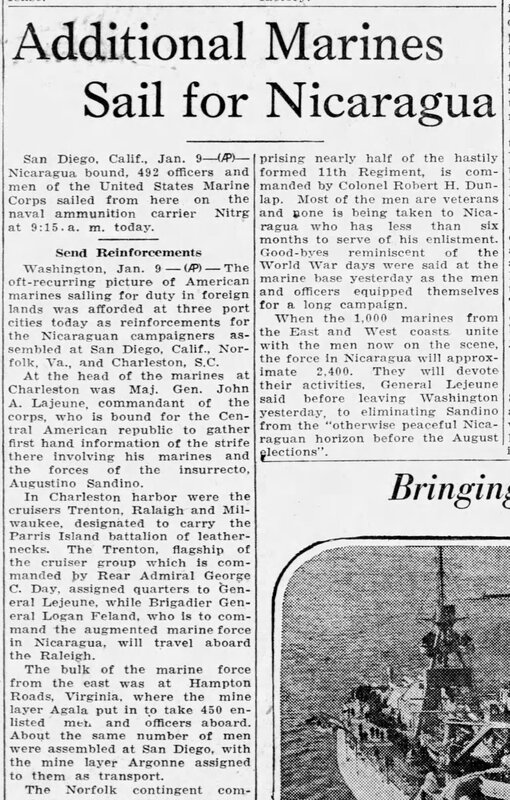
In Leon the dust persisted. After a quick shower Roberts was "covered with dust, only a few minutes later."[3] But that did not stop him from exploring. The social scene was abuzz with Marines and locals conversing about rebels and politics, especially the Nicaraguan presidential election to take place later in the year. In fact, the presidential election was largely why Roberts and the surge of Marines were in the country. En route to Nicaragua himself, the Marine Corps Commandant Maj. Gen. John Lejune supplied newspapers with the Marine's primary mission: "They will devote their activities to eliminate Sandino from the otherwise peaceful Nicaraguan horizon before the August elections."[4]
For Roberts that meant he and his fellows in the 2nd Marine Brigade, 11th Regiment were to report to the "Northern Area" of Nicaragua which bordered Honduras. Marine historian Bernard Nalty would describe this region in the late 1920s as "sparsely populated, given over to coffee plantations, a few mines, and small farms, these states (Nueva Segovia, Esteli, Jinotega) were the Nicaraguan equivelant of the America's Wild West. In times of peace, law was seldom enforced in this area; in times of revolution, never."[5] Here Sandino's rebels operated with impugnity.
To make his way to the Northern Area Roberts had to wait in Leon until a convoy of 100+ bull carts was organized before treking the nearly 175 mile trail to the city of Ocotal. The march was to be a two-aday affair: "we will march from 1:00 a.m. to 7:00 a.m. then from 3:00p.m. to 8:00 p.m. daily and it will be hell."[3]
Yet two days later, Roberts was still in Leon. They had only managed to hire 44 ox carts. Frustrated at the inaction he vented, "We never know from one minute to the other what we are to do. All the other outfits that arrived here were just issued a lot of nonsensical orders and balled us all up and nothing has been accomplished. Nobody seems to know what it is all about and I'll be damn glad to get out of here for anyplace but I suppose I'll feel sorry after I leave for I hear this [Leon] is the best town in Nicaragua - God help Nicaragua."[6]
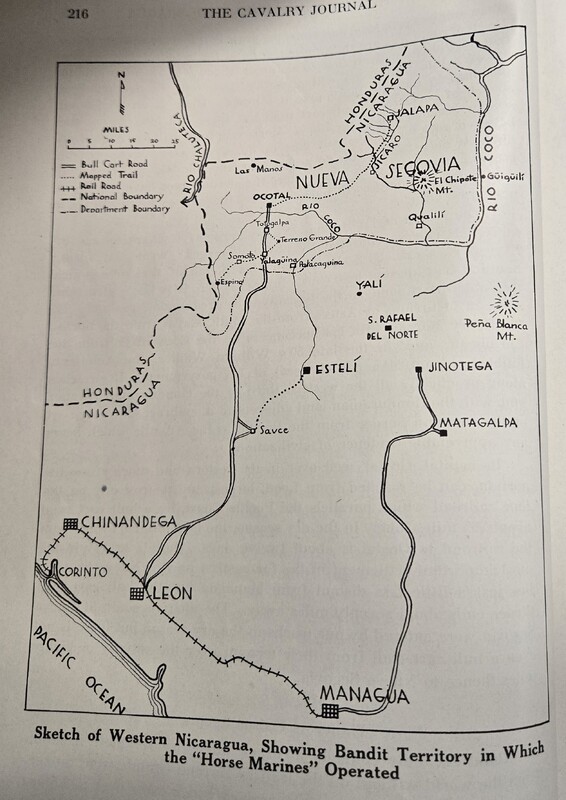
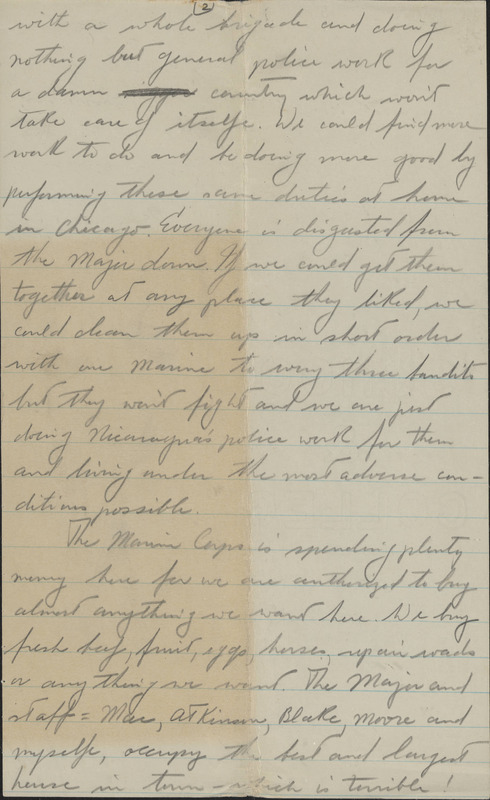
By mid-February Roberts had advanced to Condega, still some 30 miles from Ocotal, which was the main operational camps for the Marines in the Northern Area. He was not the only one still far from the action, "from all we can find out, our battalion will have it's headquarters here (Condega) for some time. our men are scattered over more than a hundred square miles in detachments of about a platoon each and are garrisoning small towns and patroling." As destablizing as this was, what was perhaps more unsettling was the culture shock of fighting against an enemy who had suddenly made himself scarce in a locale that was their own.
"Everyone is disgusted from the Major down. If we could get them together at any place they liked, we could clean them up in short order with one Marine to every three bandits but they won't fight."[7]
During downtime Roberts and his fellow Marines wrestled with boredom. To pass the time they gossiped, wrote letters, smoked cigarettes, drank alcohol (a treat considering Prohibition was still the land of the law back home), slept, improved the camp, talked politics, read magazines, and hunted for the mess officer, Norman. On one such occasion Roberts and two other officers, Captain Blake and Captain McNulty, found eight hand grenades and gleefully lobbed them into the river. The explosion netted them between "40 and 50 lbs of fish, over half a large potato sack full" and promptly delivered them to Norman for dinner.[8]
Food in Condego made by the mess officer was well received, but on lengthy foot patrols getting a meal was a different matter. On one particularly long trek through the jungles in search of Sandino Roberts and his fellows turned to local cuisine: "we got so we could live on native chow alright but all contracted diarrhea and are glad to get back to Condega and some castor oil and a rest."[9] He reported to his wife that he had lost a bit of weight as a consequence.
Within the first two months of arriving in Nicaragua Roberts had met with a battery of sensations: exhaustion, confusion, culture shock, pervasive dust, new food, lack of infrastructure, and an enemy who was so elusive as to be nearly existential. In response to these uncomfortable sensations he begged his wife to send more letters, magazines, newspapers, and Chesterfield cigarettes (as he could only find Camels in country.)[6,7] Roberts' initial reaction against the newness of the somatic changes he was experiencing was to reach back to the comforts of home.
That inclination was soon to be replaced by the excitement of patrolling on horseback and his first shot at commanding Marines under fire.