Aftermath and Meaning
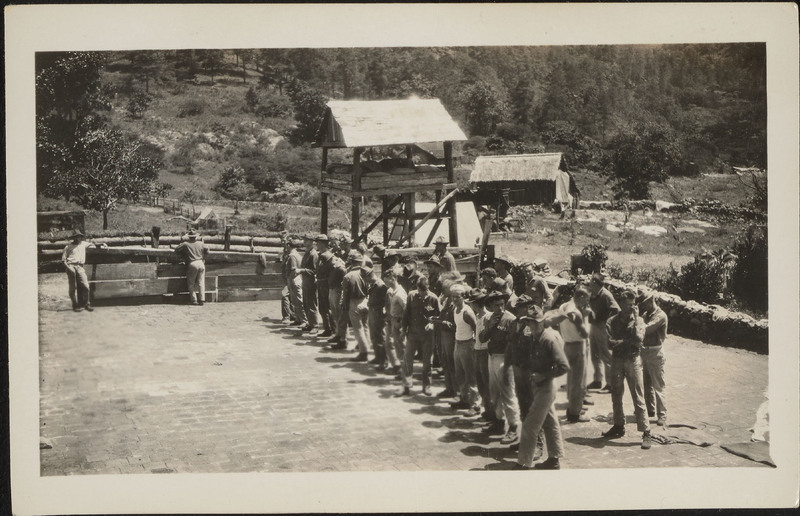
"The Coco River “party” is over. We arrived here last night – and what men! As low as they were physically we left Pueblo Nuevo at 8:00 a.m. on foot and hiked 28 miles arriving at Ocotal at 5:30 p.m, one day, wading rivers, herding a pack train. The men looked like ghosts but hiked into Ocotal with a false spring in their steps, a set smile on their faces; but pale as ghosts and no color in their lips. I am sorry to see it break up for they are the finest set of men I have ever seen."[1]
The Coco River Expedition had lasted from September 4th to their recall on September 26th. Objectively the expedition was a failure. They did not make it to the East coast nor did did they manage to establish a camp on the Coco River. However, the meaning Roberts took from his time in the Coco River Valley with his men was not one only of failure. He admitted to his wife that despite his disappointment, "I believe it's a wise move" to be recalled.[2]
The trek back to Daraili took nearly a week. First the expedition members had to wait for oxcarts and mules to be organized to meet them at the base of the river. Climbing out of the valley without hoof power for the already exhausted Marines was an impossible notion. Especially considering the illnesses the men had contracted: "We have had to move pretty slowly as we have lost one man by drowning, have one insane, five amoebic dysentery, eight dengue fever and five grippe plus nine convalescents from different things."[3] Over half of the Coco River Expedition members were suffering from an acute illness at the time of recall. A matter which had been made worse by the fact that their Navy Doctor had lost his medicine pack on the very first rapids.
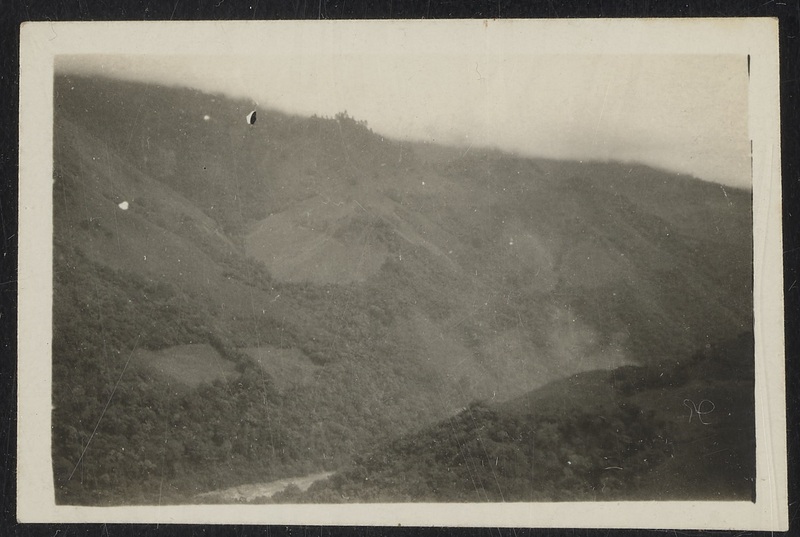
Once the pack train arrived the mens' final act before leaving the Coco River was to burn the boats. Roberts could not help but to take a snap with his camera on his way up the mountain side. Though the mission went up in flames one thing was clear: that the Marines had performed superbly. Roberts was certain that the failure of the mission was not due to any shortcomings on behalf of the Marines, but rather that the objective was impossible.
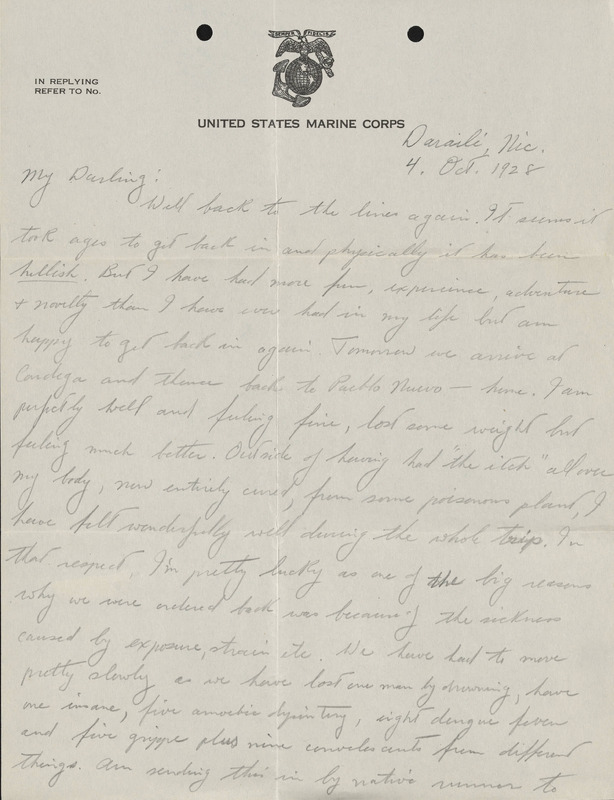
"The work performed was enormous and man killing but the men worked like fiends under a terrific strain but had the most remarkable moral[e] of any organization I have had the pleasure of serving with."[4]
Roberts processed the meaning of the Coco River Expedition through the lens of what it meant to be in Marine Corps and his position as commander of the group. The objective of the expedition may have failed, but his men and his leadership had not - they had stuck it out until they were recalled. They had labored through 24 rapids, overcoming with brute strength rough currents and waterfalls. They had back-breakingly cleared jungle for camps, had treated their own injuries, had overcome psychological discomforts of seeing one of them killed. They had disregarded the natives who "thought us crazy were afraid of bandits and swore the river was not navigatable." Regardless, Roberts writes his wife stubbornly, "we went ahead."[4].
On October 10th, now back in camp, Roberts reflected on the expedition and came to the conclusion that the main issue with his team "was all their reserve vitality had been sapped." The daily grind on the river plus the psycological toll of "one lad drown in a rapid, another injured when a plane dropped 35 lbs. of rice on his head and we had a sick list of over half the command" had been too great on the men. Despite that they had continued until "the general decided that the cost of the trips was not commensurate with the military value of the expedition. They recalled us...And I am glad to be back."[4] Roberts repeats to his wife over mulitiple letters that they were recalled by the General and that he was happy for it. The recall was not Roberts' decision, it was out of his hands. His men had given their all, and would have continued to do so despite the irrationality of it, and that fact made Roberts proud. At the same time, he trusted that General Feland would not risk expending Marines for an unsurmountable task.
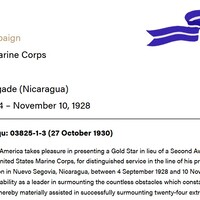
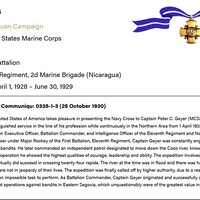
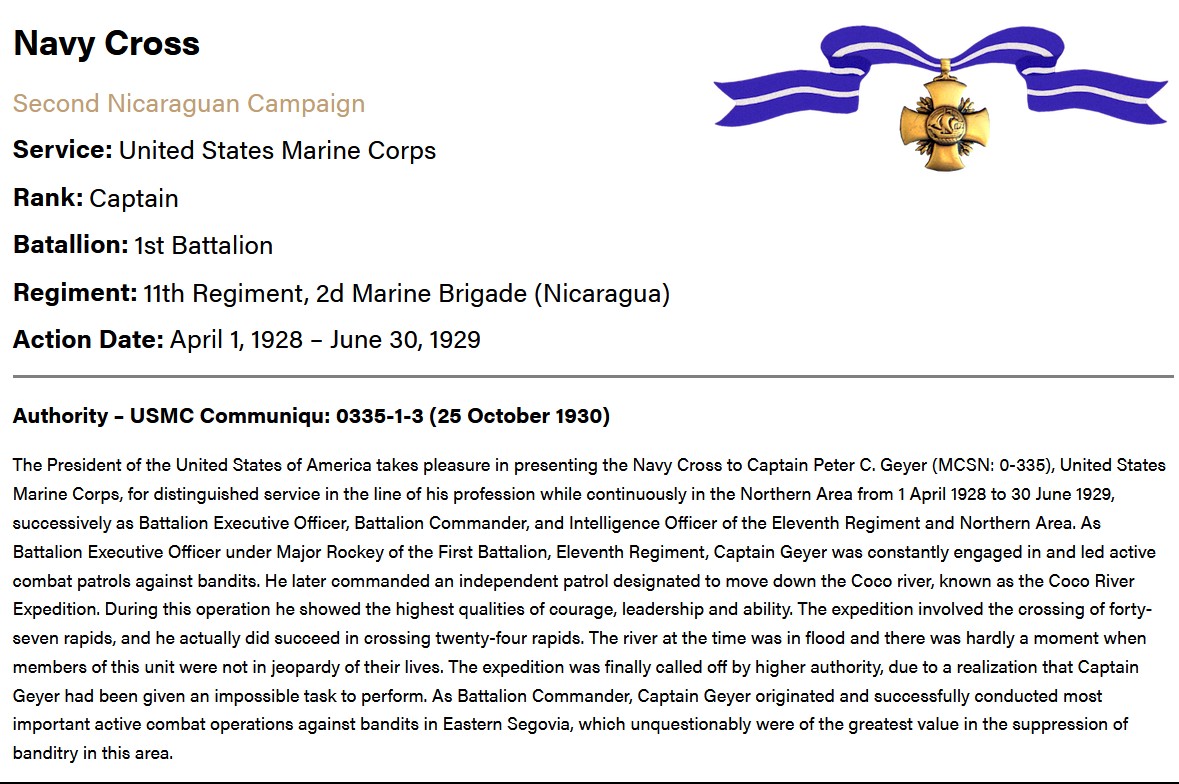
Two years later the Marine Corps validated his interpretation and association of meanings of pride, persistence, and courage that the Marines had displayed on the Coco River Expedition by awarding both the commanders with Navy Crosses. The text from both highlights Roberts and Geyer's display of "the highest qualities of courage, leadership and ability" in the face of having been given "an impossible task to perform."[5]
The sense-making of this tremendous effort, as told by Roberts to his wife over months, was that he viewed himself as partaking in a grand adventure. That the Marine Corps had entrusted him with the care of men whom he viewed as of the very best sort of individuals. And that all the physical discomforts, stenches, itching skin, strained muscles, diahrrea, dust-strained eyes, were worth the cost of leadership. That the exertion on the Coco River was to be considered good, even if not successful. When boats were smashed the men "had a good laugh," and when stray branches sliced open their faces on the river they would continue "floating merrily along."[3] The somatic discomforts experienced on the Coco River Valley, at least for Roberts, could be transmuted through the lens of his association of the Marine Corps into worthwhile experiences of manliness, leadership, and adventure.
That is, at least, if you believe his letters.
Sources:

[1] Correspondence from Harold C. Roberts to Faith N. Roberts 10 October, 1928, Folder 29, COLL 2678, Archives Branch, Marine Corps History Division, Quantico, VA, 1.
[2] Correspondence from Harold C. Roberts to Faith N. Roberts 26 September, 1928,  Folder 26, COLL 2678, Archives Branch, Marine Corps History Division, Quantico, VA, 1.
[3] Correspondence from Harold C. Roberts to Faith N. Roberts 10 October, 1928, Folder 29, COLL 2678, Archives Branch, Marine Corps History Division, Quantico, VA, 1-2.
[4] Correspondence from Harold C. Roberts to Faith N. Roberts 4 October, 1928, Folder 27, COLL 2678, Archives Branch, Marine Corps History Division, Quantico, VA, 1-2.
[5] Second Navy Cross awarded to Harold C. Roberts.